Historic Firearms of the American Southwest
Lever-action rifles, revolvers and working shotguns tell a story of movement, craftsmanship and adaptation across the Southwest.
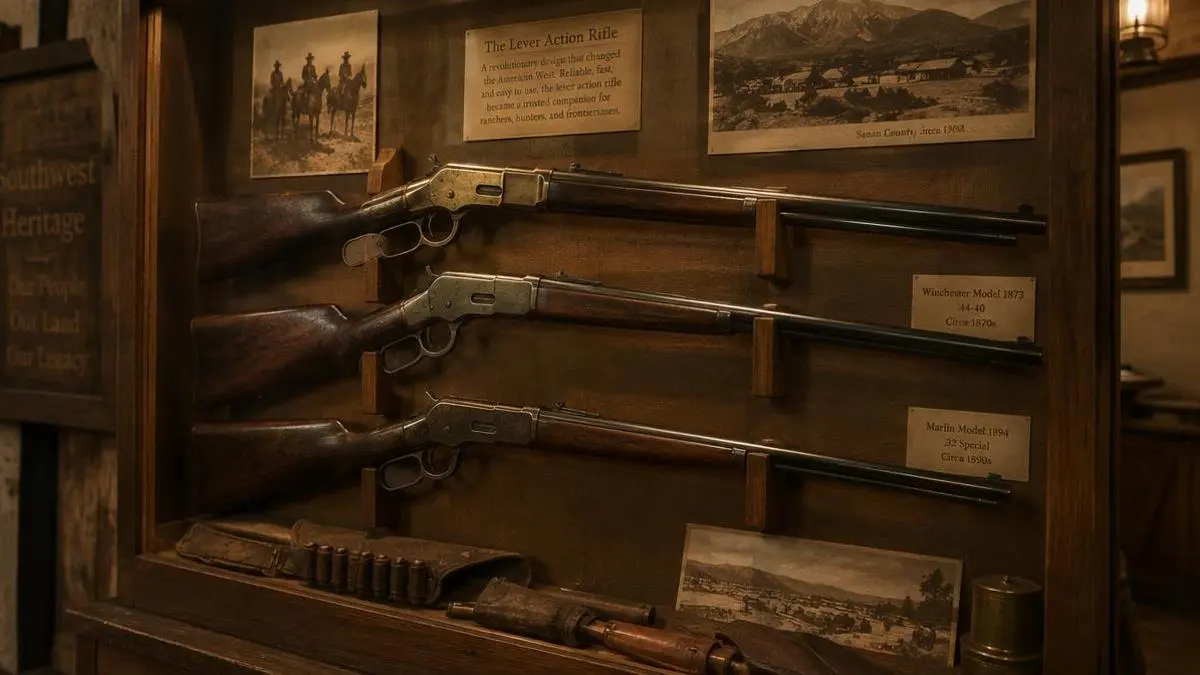
The firearms associated with the American Southwest are remembered because they solved real problems. A rifle had to ride in a saddle scabbard, survive dust and still work when the weather turned. A revolver had to be carried comfortably for long hours. A shotgun might serve on the ranch, around a camp or in the hands of a market hunter. Their history is the history of people adapting useful tools to a demanding place.
The appeal of the lever-action rifle
Lever-action rifles offered a practical combination of compact handling, quick follow-up shots and familiar controls. They became part of ranch life and popular culture, but the working versions were valued for reliability rather than romance. Small variations in stock shape, barrel length and cartridge tell collectors how a rifle was meant to be used.
Revolvers, travel and personal responsibility
The revolver became a symbol of the frontier because it was portable and mechanically understandable. Historical examples also remind us that ownership carried obligations: keep the gun maintained, carry it securely and understand where it was lawful to use it. The story is more interesting when the hardware is considered alongside the people and rules surrounding it.
- Look for provenance, markings and a consistent history of ownership
- Study condition honestly; original wear can be more valuable than careless restoration
- Handle historic firearms as unloaded until they have been professionally checked
- Learn the laws governing transfers, transport and display before buying or selling
Historic firearms are not only metal and wood; they are memories of the people who used them.
Collectors preserve engineering, but they also preserve context. A careful collection can show how a community worked, traveled and protected itself without turning the past into a costume. That balance is what keeps Southwestern firearm history meaningful.
Tools shaped by the frontier
Historic firearms of the Southwest reflect the problems people needed to solve. A useful arm had to be carried on horseback, stored in a saddle scabbard, maintained with limited supplies and trusted far from a repair shop. Lever actions offered a practical balance of capacity and speed. Revolvers were compact and familiar. Shotguns served on farms, in camps and in hunting country. Their importance came from the work around them, not from the mythology added later.
Craftsmanship and adaptation
Manufacturers adjusted designs to suit dry climate, long travel and the mixed demands of ranching and hunting. Wood, steel, leather and simple mechanical parts were chosen because they could be repaired and understood. Surviving examples often show honest wear: softened checkering, replaced screws, a stock repaired after a hard journey. Those marks are evidence of use. They also remind collectors that a historic firearm is both an object of engineering and a record of somebody’s life.
Preserving history responsibly
Handling a historic firearm begins with identification and safe storage. Do not assume that an old action is safe with modern ammunition, and do not alter an original piece before consulting a qualified specialist. Documentation matters: record the maker, model, markings, provenance and any work performed. Museums and private collections serve the community best when they explain context, acknowledge uncertainty and show how technology, labor and local conditions shaped the firearms people relied on.
Reading an original firearm
Collectors learn to slow down. Start with the overall design, then note markings, proof symbols, stock details and signs of later work. A photograph of each mark can be more useful than a guess based on appearance. Reputable references and a qualified appraiser help separate a documented fact from a family story. That care protects both the history and the value of the object.
Myth and material evidence
Popular stories often compress decades of technology into a single heroic image. The surviving firearm tells a more nuanced story. Wear patterns, repairs and manufacturing changes show how people adapted equipment to real work. Comparing an object with period catalogs, photographs and local records can reveal what is original and what was added later. Good history welcomes that complexity instead of smoothing it away.
A responsible collection
Historic firearms should be stored securely, kept away from corrosive moisture and handled with clean hands. Keep provenance notes with the collection, not loose in a separate drawer. If a piece needs repair, choose a specialist who understands both safety and preservation. A responsible collection is not defined by size; it is defined by the quality of its documentation and care.
Why the Southwest still matters
The American Southwest offers a clear example of how technology follows geography. Long distances, limited services and changing work shaped what people carried and how they maintained it. Studying those choices connects mechanical history with the lived experience of ranches, mines and small towns. That connection is what makes a historic firearm worth learning about beyond its appearance.
The collector’s responsibility
Owning a historic firearm means becoming a temporary guardian of information as well as metal and wood. Keep records readable, explain what is known and unknown, and resist the urge to turn every object into a legend. Careful stewardship lets future owners study the same evidence and understand how ordinary people used technology in an extraordinary landscape.